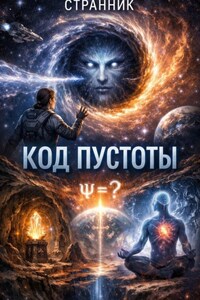
"What are you thinking about?" someone asked him. But Mark didn't answer; he was staring intently at a point. It grew every second, turning into a large black hole around which an ocean raged, flooding all remaining space, the darkening, gloomy sky. "Here they are, the gates!" Mark realized. "The name is written above: 'Moments', where two paths collide – the past and the future."
He heard the voice again:
"Enter these gates, my friend, and the question of everything: 'Do you want this again and again, countless times?' will weigh heavily on all your actions. If you say 'yes' to joy, you will also say 'yes' to all sorrows. Everything is interconnected…"
And Mark entered that space.
Chapter 1.
Mark's father's parental home, where they settled after moving, was in Kashgarka. It was a typical old district of a Central Asian city, with clay fences and houses. The windows of the houses faced only the inner courtyards, where it smelled of latrines and grass didn't grow because it was traditionally uprooted to leave the ground bare. Every morning, a young Uzbek woman swept the yard. Immediately after waking up, she usually covered her face with her hand as she was supposed to be ashamed of sleeping with her husband at night. So before starting her routine of sweeping the yard, she had to wash.
In these courtyards, trees grew, creating shade where topchans, covered with carpets and bolster pillows, were laid. Topchans were Uzbek table-beds where people reclined during meals or when receiving dear guests.
The age of Tashkent, as this city was called, where they moved to live, was over two thousand years. At the end of the nineteenth century, it was part of the Russian Empire, a province where high-ranking nobles who were displeasing to the royal family were exiled. For instance, Nikolai Konstantinovich Romanov, the grandson of Emperor Nicholas I, ended up in Tashkent.
Here, in the sunny land with fertile soil, an abundance of fruits, and rich wheat harvests from which rosy flatbreads were baked, many celebrities found temporary refuge. Some were exiled by the Bolshevik government after the 1917 revolution. Some fled from hunger, cold, others – from World War II. Alexander Solzhenitsyn, a Russian writer in exile and future Nobel laureate – an outstanding "Russian imperialist," nationalist, and anti-Semite, was treated in Tashkent for cancer. He wrote a famous novel about the suffering of his people in communist prisons and camps, revealing the crimes of Joseph Stalin. Solzhenitsyn, by the will of fate, became a victim of the communist regime, while Stalin, also an "imperialist," became a dictator and tyrant. Another Nobel laureate, Joseph Brodsky, a highly talented poet but with a rather vile soul, also visited Tashkent.